Monday, May 31, 2010

The Yurt in Stanislaus - Rain!


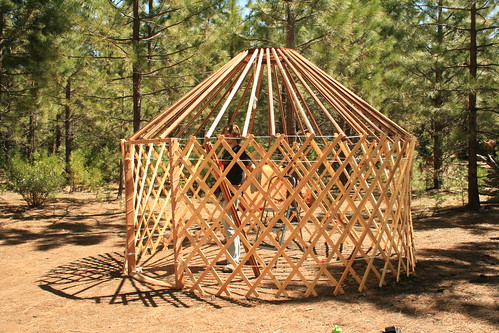
Yurt Frame
Setting up the yurt frame on a nice level area.


I finally got another chance to take the yurt camping, this time in the Stanislaus National Forest near the Hwy 120 entrance of Yosemite National Park in California. My dad and I searched for hours, driving down national forest roads, to find the perfect spot to set it up. We encountered a lot of steep terrain which was not ideal to set up the yurt, since it needs to be as level as possible. If the ground isn't level, then the roof will end up pushing down more on the khana downslope, causing uneven stresses on the frame. We were also looking for a spot with flat ground (not bumpy) and cleared of vegetation. We finally found a spot near Camp Mather, off of Evergreen Rd.
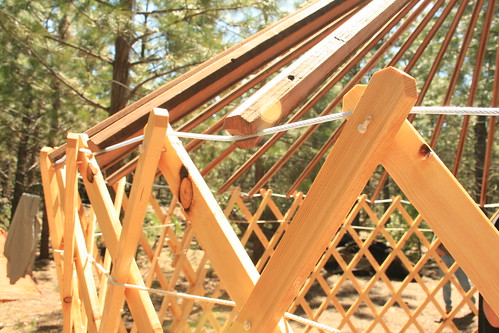

Yurt Frame
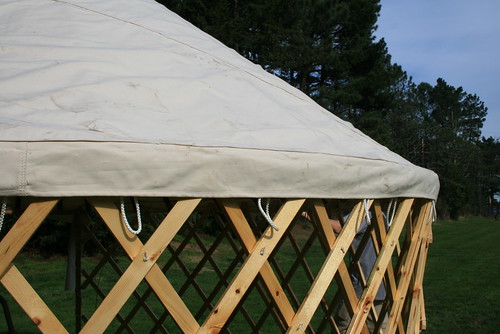
A close up of how the roof poles rest on the tension cable.


Unfortunately, before we got everyone together at our campsite, it was already past midnight. We spent the whole day looking and didn't get everything together to start building the yurt until after dark. So we slept in tents and the next morning, we started building. We had plenty of time, and spent about two hours putting it up. Even though we tried building the yurt on a spot as level as possible, the ground was still slightly at an angle, but what can you do? We built the door downslope so that our heads when we sleep inside the yurt would be away from the door.
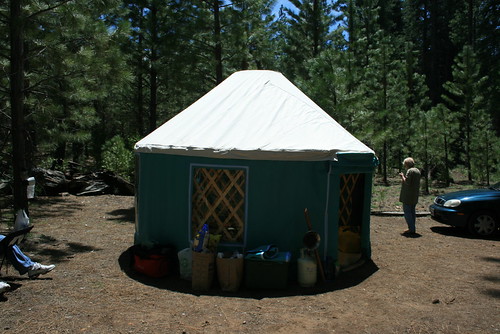

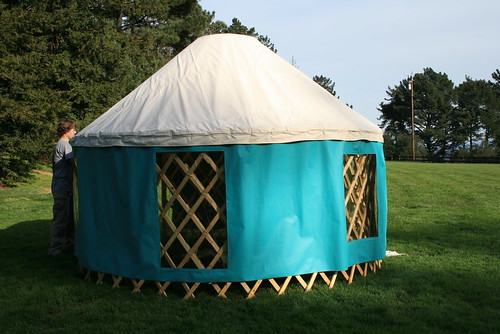
Yurt in Forest
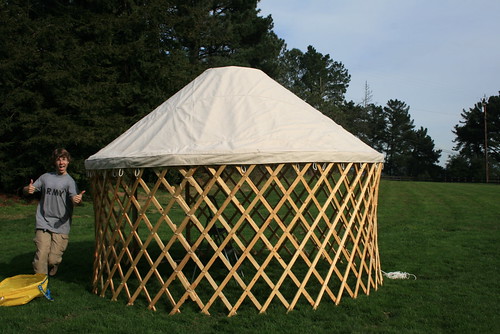
All done! The door is rolled up.


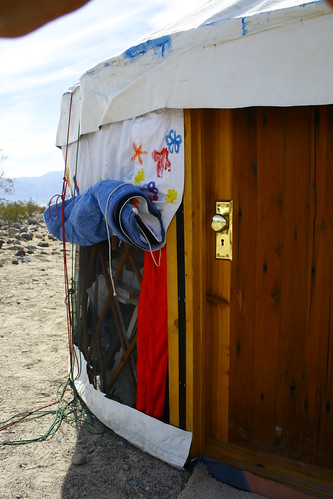
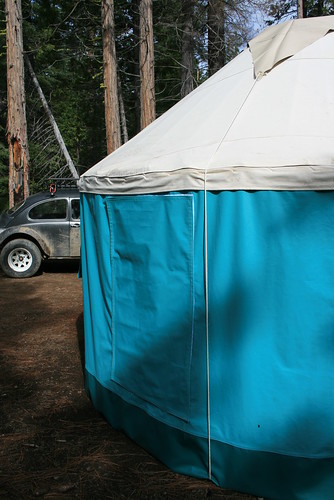
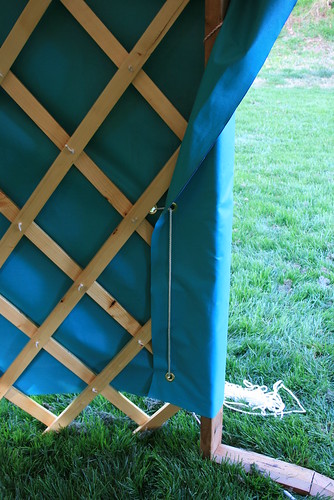
Yurt Door
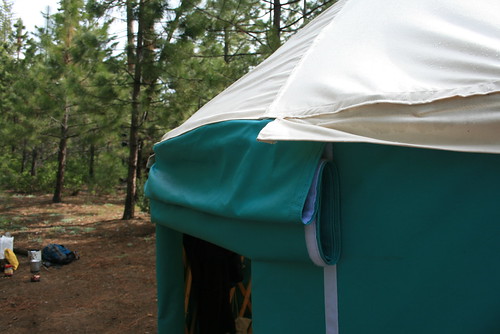
Close up of the rolled up door.


We also tried a new way of rolling up the door. It was pretty simple, in fact. All we did was roll up the door from the outside, and then unfold the roll at the top so that some of the velcro was stuck to the velcro of the walls. This small amount of velcro (about 3-4 inches) was strong enough to hold up the entire rolled up door. It worked well, and we didn't need any ropes to cinch it up as we originally thought. Also, the Sierra Nevadas are a really dry mountain range with few bugs, so we were able to keep the door open all day and the only bugs that crawled into the yurt were a few large ants. If we end up taking the yurt anywhere else, I will consider making a screen door insert.
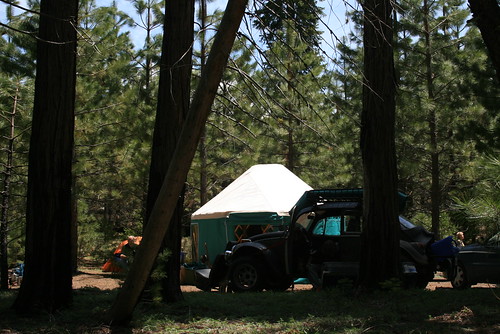

Yurt in Forest
Our camp spot in the forest.


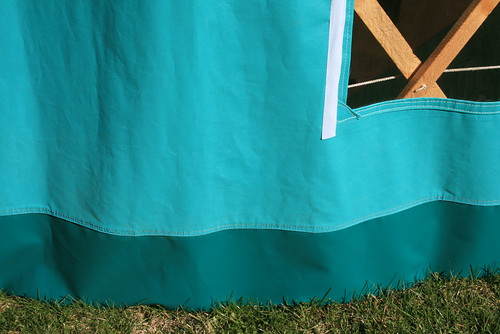
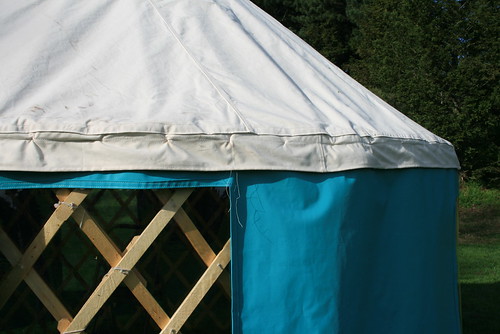
Now, as the title of this post suggests, it rained on the yurt while we were camping. It didn't rain really hard, but it did drizzle for a few hours, and there were interspersed periods of heavy rain that lasted 1-5 minutes. I was very excited when it rained because this meant I would be able to see how the yurt stood up to the water, and if the canvas was really as water resistant as I've heard. My mom was relaxing inside of the yurt at night while it was raining and she said the sound of the rain on the roof was very relaxing. The rain drops that hit the canvas balled up and rolled off. The canvas soaked up very little of the water. The area where the most water was actually soaked up by the canvas was at the roofline where the canvas was stretched tightly around the end of the roof poles at top of the walls. Some dirt got splashed up off the ground and hit the bottom band of the yurt wall. But since this section was made of vinyl, it was easy to wipe off. The walls also got wet, but the water just rolled down and never soaked in. The next day was sunny and warm, so the yurt dried out completely.
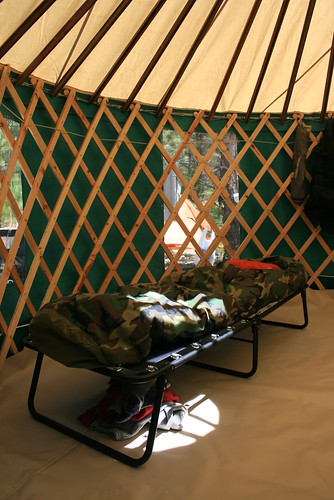

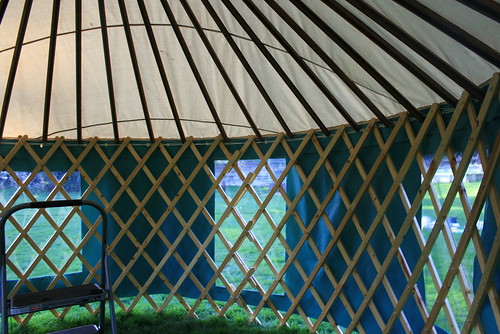
Cot in Yurt
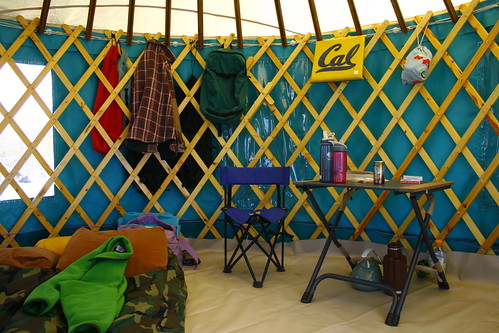
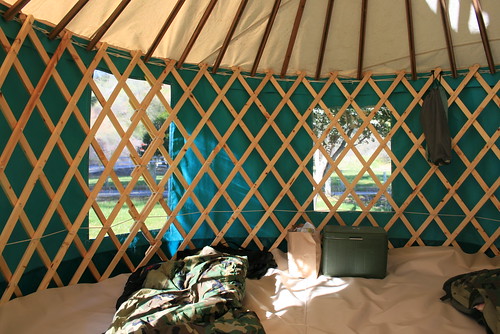
Setting up the cot inside.


Another thing we tried for the first time is sleeping on a cot in the yurt. This was actually really nice and made it feel like a house or cabin in the woods rather than a fancy heavy duty tent. Sleeping on the ground still makes you feel a bit more like you're camping in a tent, but the cot was great. It also added the benefit of putting stuff under the cot which freed up floor space.
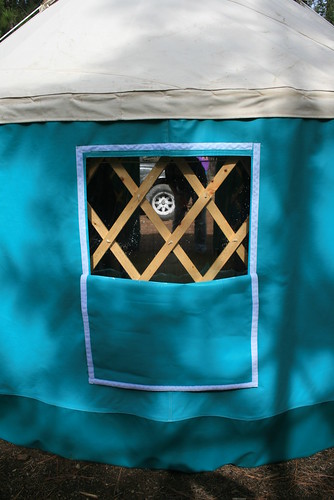

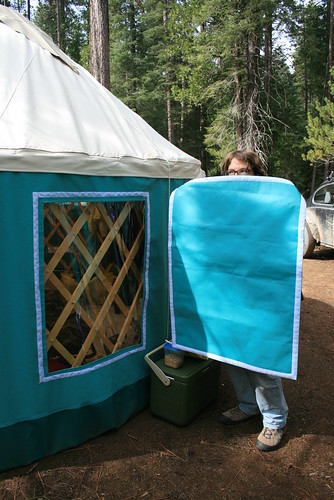
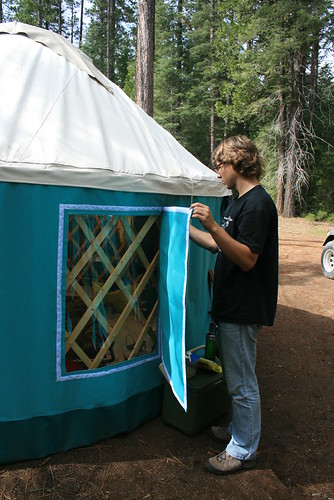
Yurt Windows
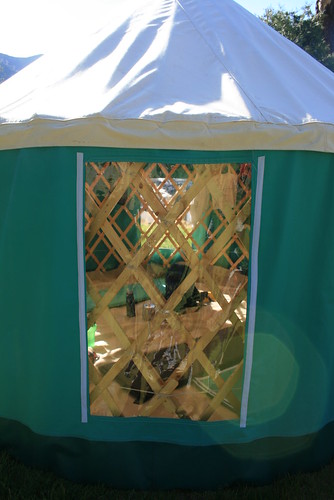
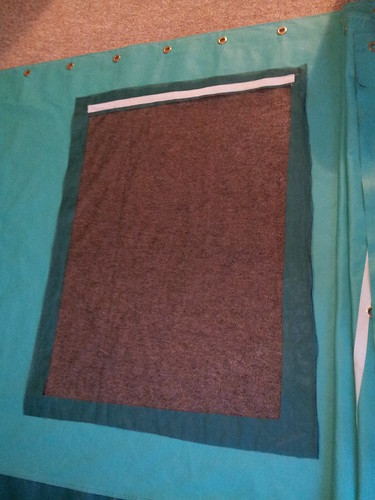
A window cover halfway on.


Since it was hot during the day, about 75 degrees and sunny, we wanted to keep the yurt as cool as possible, which was hard since it was in the direct sun around noon. We tried covering the south facing windows with the window covers I just finished before we left on the camping trip. This worked pretty well, and kept the yurt a lot cooler than if the windows were open to the sunlight.

Finally, as we packed up, we noticed that the ground underneath the yurt was really moist, probably from all the rain and the recently melted snow in the area. The vinyl floor and the vinyl bottom band of the walls were very wet when we were packing up the yurt and some parts were covered with mud and wet soil. This shows the importance of the vinyl bottom band, because it doesn't allow the water in the ground to be soaked up by the canvas of the walls since vinyl doesn't absorb any water. It was very easy to take a rag and wipe down the mud/water from the vinyl floor and bottom band when we were packing up, ensuring that the yurt was packed away dry.

Friday, May 21, 2010

Yurt Window Covers

One of the last things I just finished on the yurt are the window covers. Since I sewed the clear plastic directly into the wall cutting out the canvas material, I had no way to cover the windows unless I made covers. I thought about different ways to attach the window covers, like heavy plastic zippers, rope and grommets or velcro, and the velcro won. It also made the most sense to attach the window covers on the outside of the yurt, which at first sounds inconvenient, but its not actually that bad. Attaching the window covers on the inside would be nearly impossible since the khana are in the way between you and the canvas wall and windows. If you want to open up the window covers to let in light in the morning, you have to go outside. Also, if somebody walks by, they can just yank open a cover an look in. But so far, I haven't encountered any weirdos in the middle of the forest that have done that. And usually in the morning when I need a bathroom break in the woods, thats also a good time to open up the covers to let some light into the yurt.


Yurt Windows
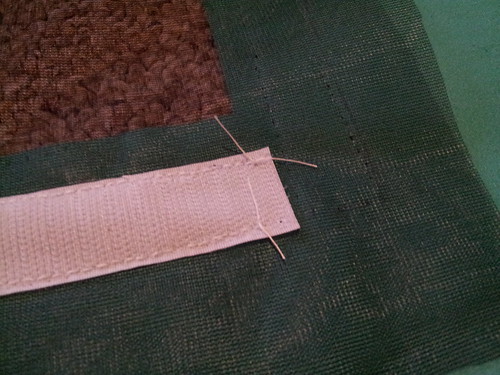
Close up of the velcro that attaches the window covers.


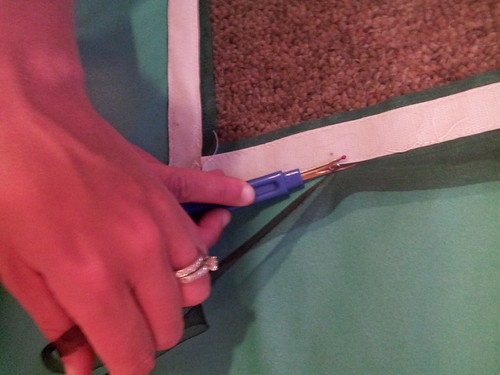
I started by sewing the hooked part of the velcro strip onto the canvas wall bordering the windows. Then I measured out a slightly over-sized piece of canvas which would be the actual cover, and hemmed the edges. Finally I sewed the fuzzy soft part of the velcro strip around the edges of the canvas cover. I chose to put the hooked side on the yurt wall because it is easier to clean if the wall gets dirty. The covers have a better chance of staying clean.

Yurt Windows
The first step is to get the window cover aligned with the window.


I started experimenting with different ways of attaching the covers over the windows. Since they attach with velcro, you can slap then on almost any way you like. The best option I found was to put the window cover on completely, and then peel back the cover until you expose enough of the window to let in as much light as you want.


Yurt Windows
The second step is to stick the window cover onto the window and press the velcro together so it sticks.


Yurt Windows
A window covered by its cover.


Yurt Windows
Peel back the window cover until you have enough light coming through the window.


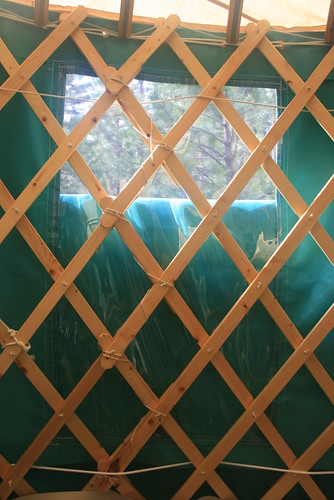
Yurt Windows
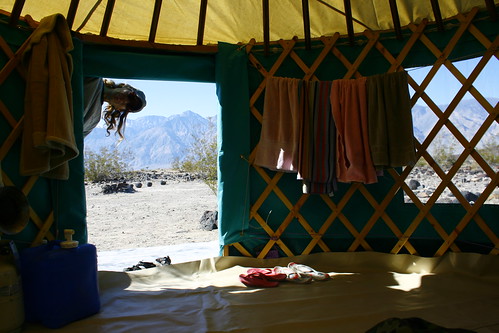
This is what a half peeled down window cover looks like from the inside of the yurt.

Monday, March 15, 2010

The Yurt at Cache Creek

We set up the yurt for a single night of camping, something we normally wouldn't do because of the 1-2 hr set up time, at the Yolo County Cache Creek campground when we went camping with the vwcamperfamily. John LaTorre was going to be there, the guy who lent me the industrial sewing machine, so we thought we'd set it up and show what I sewed with his machine.

This time, we were able to set the yurt up on semi-level ground. That made the shape much rounder and the wall was less saggy then when we set it up in the desert. We also finished partially sewing on some velcro for attaching the window covers. Here are some pictures:


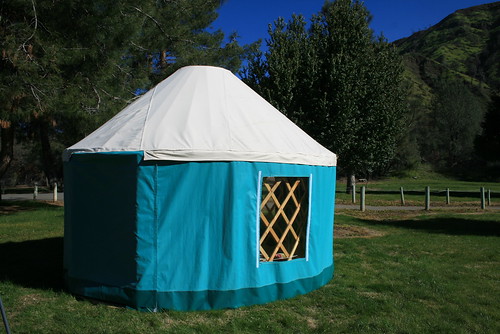
My Yurt at Cache Creek
The yurt set up with the door flap closed.

My Yurt at Cache Creek
Two strips of velcro that hold the window covers on (but only partially)

My Yurt at Cache Creek
The vinyl bottom band is tucked under the khana. Canvas doesn't touch the ground.

My Yurt at Cache Creek
Inside the yurt, with the ground cover all wrinkled up.

My Yurt at Cache Creek
We hung the lantern from the crown by a rope.

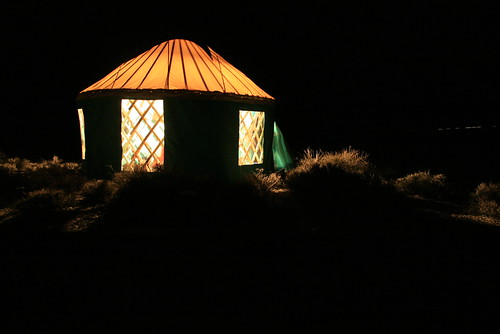
Night at Cache Creek
The yurt at night. The rest of the windows are covered by the window covers.

Monday, March 8, 2010

Maiden Yurt Voyage: Have Yurt, Will Camp


Warm Springs Rd
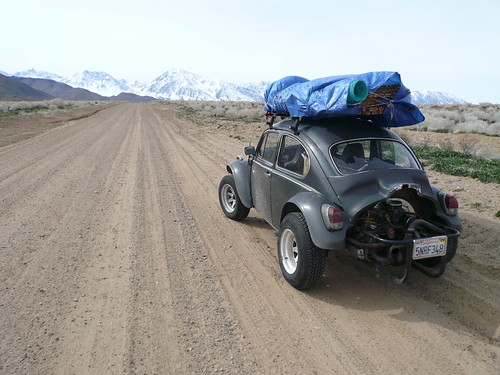
Yurt on the roof of the baja, heading into the mountains!


The day had finally come when all of the months of work on my yurt came to a finish (not exactly) and we were able to pack it up and take it to the mountains on its maiden yurt voyage. I know, I could of taken it somewhere easy and simple, like the local campground or something, but as with most of the things Romy and I seem to do, we go big or go home! So there we were, driving the baja over to the Eastern Sierra.


Baja-ing
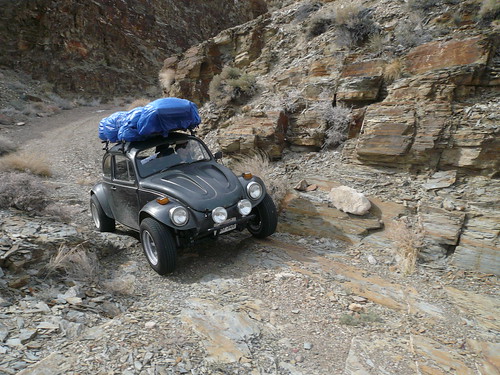
Driving off-road in the Inyo National Forest to find a perfect spot to set up the yurt.


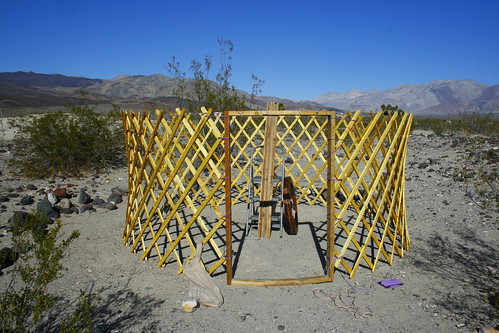
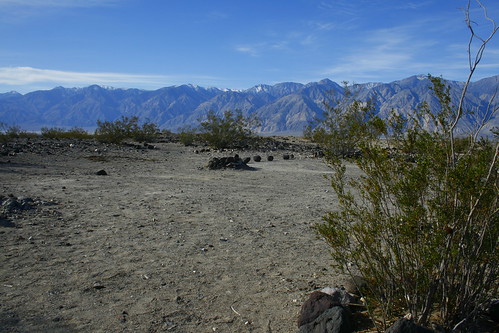
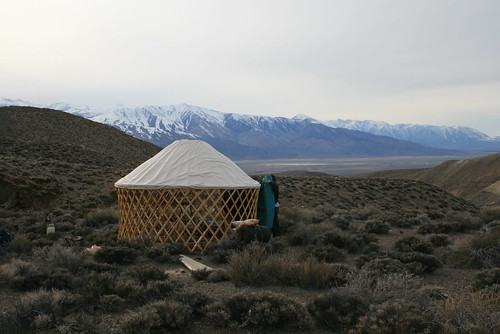
We picked a spot east of the Owen's Valley, in the Inyo National Forest, just outside of Death Valley National Park. We found an off shoot road from CA 168 out of Big Pine which headed into Death Valley, called Death Valley Rd, and it was off another off shoot road where we drove the baja off road into a canyon and found a nice place to set up on the top of a ridge. We were situated at about 5,500 ft with an awesome view of the Sierra Nevada mountains across the Owen's Valley. Before we left on the trip, I had visions in my head of setting up the yurt in the valley near Mammoth Lakes, CA, but it had too much snow. That's why we headed farther south instead.


Maiden Yurt Voyage
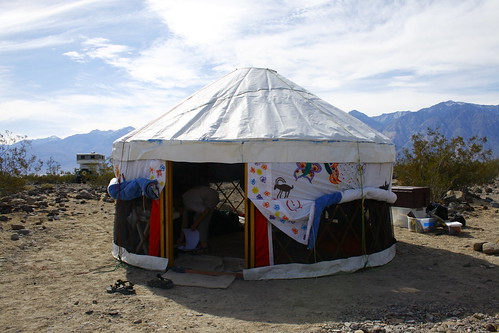
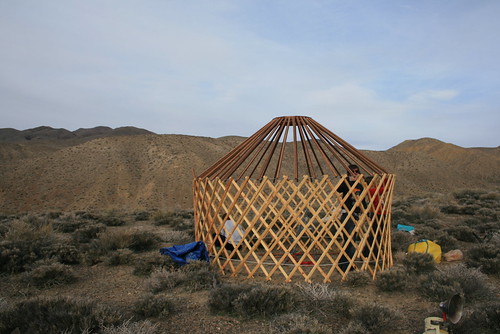
Setting up the yurt near Death Valley National Park.


Nicole and Romy found a section of a ridge that happened to have large flat spots in between desert scrub plants (I don't know what they are called). We needed to find a place that had at least a 12 foot diameter circular area clear of vegetation. We ended up having to pull a few plants out of the rocky and dry soil to clear one of the largest spots we found, but made an attempt at replanting them elsewhere. So hopefully we didn't kill any plants! The baja couldn't drive up the ridge, so we had to carry the pieces of the yurt up a steep hill. It was worth doing that in order to have the awesome view that we were able to have being on top of a ridge.


Maiden Yurt Voyage
Marcel holding the yurt wall as it is attached to the roof.


There was a steady wind blowing from the east as we worked to get the yurt put together. It took us about 2 hours to put it up, which was slow compared to how fast we were able to assemble it in the park. It was hard to get the yurt completely flat and level of the ground and perfectly round. I don't think we were ever able to achieve the round-ness and I also think we constructed it slightly less than a 12 ft diameter. But it was close! Consequently, I felt like the walls of the yurt were slightly sagging or bunched up in areas. However that didn't effect much except the aesthetics, so as the sun went down, we crawled inside and started up the lantern for light, and propane heater for warmth.


Maiden Yurt Voyage
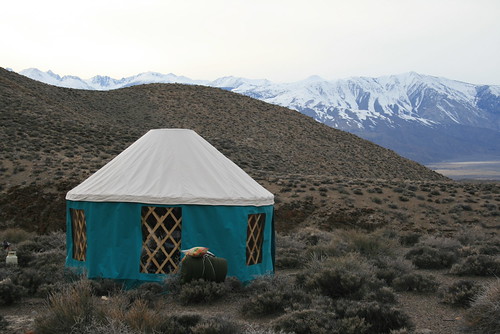
The yurt, finally all built!


Maiden Yurt Voyage
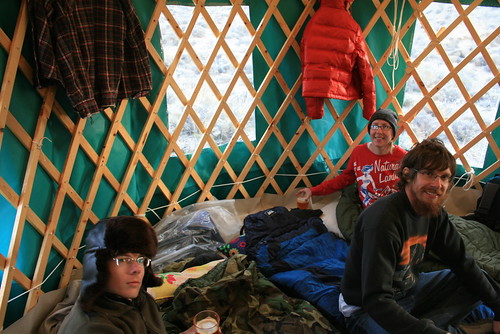
Romy, Marcel, and Nicole relaxing in the yurt.


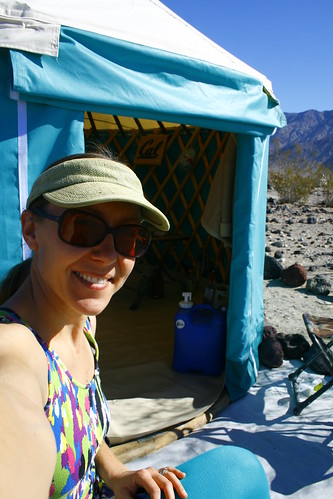
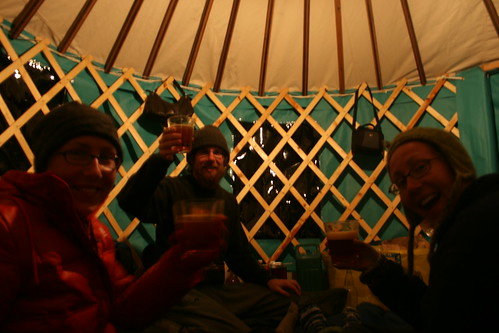
The yurt retained a lot of heat from the propane heater, which we nicknamed "the sunflower" due to its shape. We left the door flap cracked open for ventilation. We had it running the whole evening, but turned it off when we went to sleep, and turned it back on in the morning. Nicole and Marcel brought a bunch of 1 liter bottles of home brewed beer, which we drank merrily each and every night of camping in the yurt. Mmmmm. My favorite was the blonde ale.


Yurt Party!
Cheers! Enjoying a home brewed beer in the yurt.


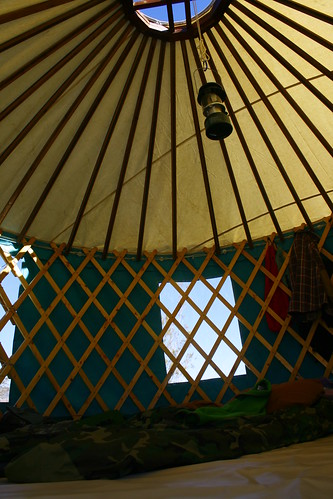
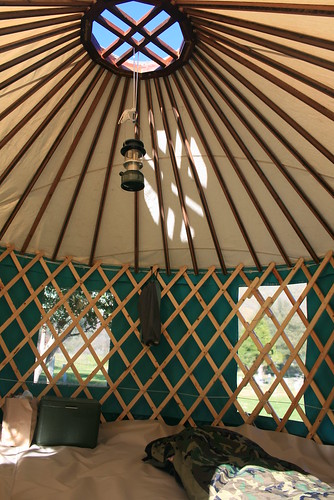
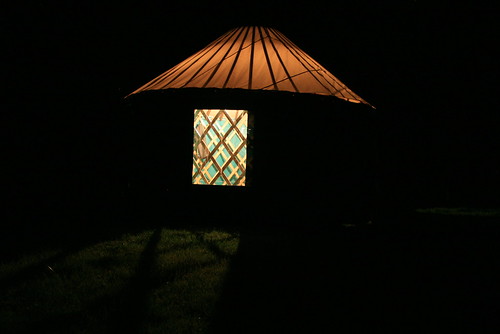
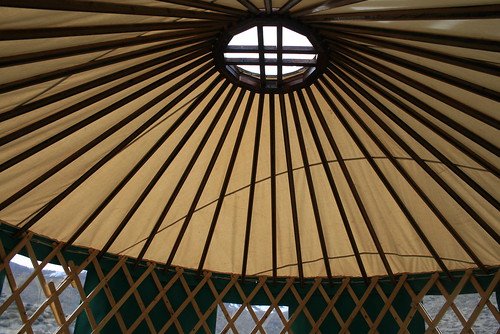
When the sun went down behind the mountains, we were able to see a lot of stars in the sky. We hung a Coleman lantern from the crown by a short rope, so we had a soft light source inside the yurt, and it looked really cool from outside. I wasn't able to sew window covers yet, however I will have to finish them this week! The wind steadily blew all night, but inside the yurt it was quiet and peaceful. When we finally went to sleep, I liked laying and staring at the roof. There was enough light outside from the moon that you could see the roof poles and the star shaped crown rain cover through the roof making a cool pattern.


Maiden Yurt Voyage
The yurt at night, lit up by our Coleman lantern inside.


After having the yurt up for only two short nights, we had to break it down and go home. Putting it up for the first time and camping inside of it was really exciting and made me feel great after all of the hard work building it. I feel like I'm done, but there are still a few things here and there that I have to finish off, like the floor, and the window covers. But nevertheless, its ready for another camping trip soon!


Maiden Yurt Voyage
Inside the yurt, with an open crown.

Thursday, February 18, 2010

Yurt Almost Done!

Before my sister, Nicole, left we put up the yurt at the park to see how well everything we sewed went together. This post will mainly be pictures, since they explain a lot more than what I could say in words.


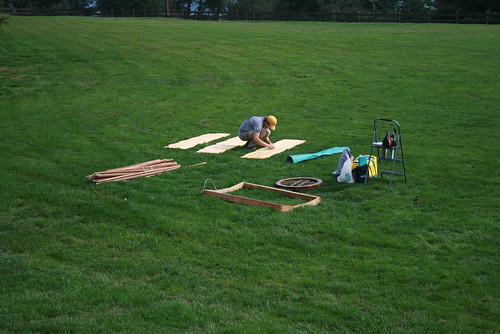
Yurt 02-16-2010
Romy setting the pieces of the yurt out in the grass. It really helps to have a step ladder.


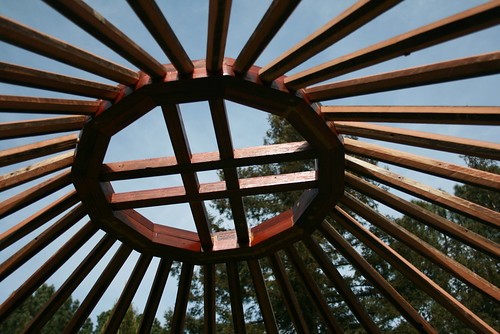
Yurt 02-16-2010
The redwood crown.


Yurt 02-16-2010
Romy pushing the roof canvas on top. Its actually pretty heavy!


Yurt 02-16-2010
Alright! Romy gives thumbs - the roof fits and the roof band is tight.


Yurt 02-16-2010
A close up of the roof and roof band. You can see some of the rope loops hanging down - that's where the wall will attach.


Yurt 02-16-2010
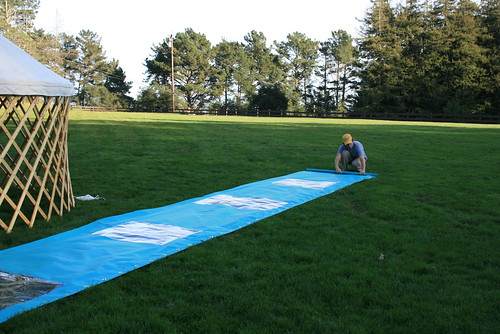
Unrolling the yurt wall. You can see all of the windows are sewn in. The wall is 36ft long.


Yurt 02-16-2010
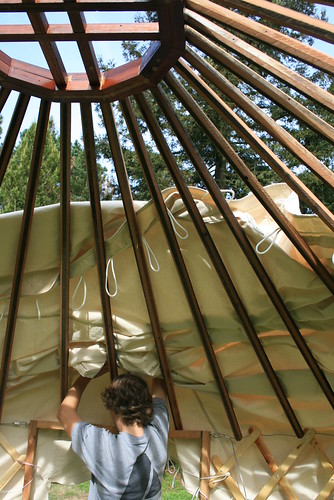
Nicole attaches the wall to the roof using the loop-rope system. The wall must be attached from the inside of the yurt by design.


Yurt 02-16-2010
The roof had to be pushed up while tying the wall to the roof.


Yurt 02-16-2010
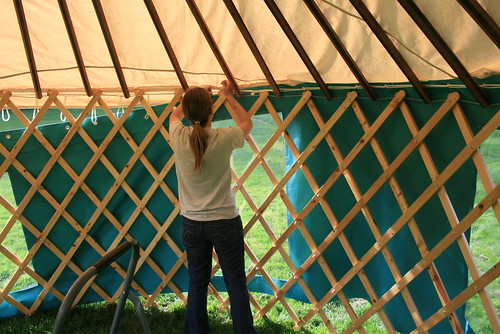
The wall wraps around the door frame and is tightened with rope.


Yurt 02-16-2010
The wall is fully attached. The bottom band isn't sewn on yet, that's why the wall is just short of the ground. The bottom band will be made out of vinyl which will not absorb water and rot.


Yurt 02-16-2010
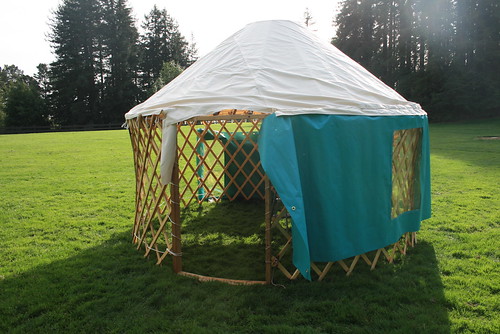
An outside view of the yurt. You can see the two sizes of windows.


Yurt 02-16-2010
The roof line and a window.


Yurt 02-16-2010
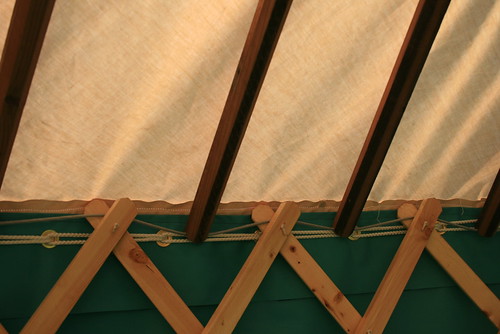
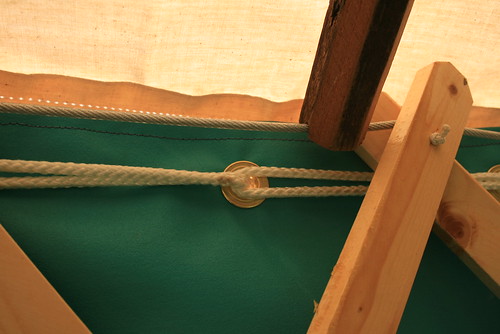
You can see in this picture how the walls attach to the roof. The loops of rope interlock with each other as you feed them through the grommets. The wall is not supported by the tension cable, as many popular designs call for.


Yurt 02-16-2010
Close up of the rope loop system.


You might notice that the yurt doesn't yet have a door flap and the wall doesn't reach all the way to the ground. I still have to complete the bottom band, which will extend the wall to the ground and connect to the vinyl floor (still have to make the floor to!) with velcro. I have to finish this all in the next two weeks because that's when the maiden yurt voyage will be to the hot springs near Mammoth Lakes!

Tuesday, February 16, 2010

Sewing the Canvas Wall

This past weekend, Nicole flew here to Oakland to come and help me sew the canvas wall of the yurt, and help me finish the canvas roof. It was really nice having a second person help measure, cut, and handle the fabric because the canvas is sooooo heavy, and the wall canvas in particular was a little stiff, making it hard to handle. Sometimes, we needed a third person (Romy), to help align and push fabric through the sewing machine. We worked all day, and late into the night sometimes too. It was really fun work, even though sometimes we got frustrated, broke a few needles, ran out of bobbin at the worst times, etc. But the sewing machines never let us down!

I used a 13oz water, mildew, and fire resistant canvas, which was dyed turquoise for the walls. The roof canvas was also a natural 13oz canvas, but was only treated for water and mildew resistance. The fire resistant coating makes a huge difference in the way the fabric looks and feels (and smells). The turquoise fire resistant canvas is stiffer and kind of shiny. The natural canvas is more flexible and easier to handle in the machine.

I also bought a 20 gauge clear plastic "fabric" for the yurt windows. It was really clear, and cost about $10/yd. There is no need to go any heavier, unless you are making large windows. I limited the width of each window to about 2.5ft so that the windows didn't take too much of the weight of the walls. We made 5 windows total, two of them were long (spanned almost the whole height of the wall), and two of them were medium length.


Yurt 02-14-2010
Cutting out the fabric behind the window.


To sew the windows on the walls, we first sewed the plastic onto the side of the fabric which will be the inside of the wall. Once it was sewn in place, we cut the back of the fabric away, exposing the window. In the picture above, you can't see the plastic window, but its there, believe me! We left about 2.5 inches of scrap so that it was easy to fold it back to make a nice border around the window. The corners were left exposed (they had no border), but we decided that it can be covered by a small triangle shaped trim I'll sew over it later.


Yurt 02-15-2010
Sewing the flaps into a nice border around the windows.


We also placed brass spur grommets at the top of the wall every 7.25 inches. Why 7.25in? I don't know, I just made that number up. I thought that spacing would be good to support the wall. The total amount of grommets was about 60, I think, supporting a wall 36ft long. I used 1/2inch spur grommets (#4), which required a special tool. The tools, called a die set, and hole puncher, are specific to the grommet size, so you will have to buy the same size tools and hole puncher as you do grommets. I ordered my tools and grommets from Sailrite.


Yurt 02-15-2010
Me and Nicole (my twin sister) with a finished window. You can also see the grommets.


Once the windows and grommets were done on the wall, that was about all that needed to be done (for now). So next we moved on to finishing the roof. We first sewed together the final seam which completed the cone shape of the roof. Then we cut off the scraps which hung over the sides to make the roof circular. Then we sewed a roof band along the circumference of the roof to make a tight roof line. On the inside of this roof band, we sewed a series of rope loops which were spaced at 7.25 inches, the same as the grommets. The loops of rope fit through the grommets at the top of the wall to join them together.


Yurt 02-15-2010
The rope loops sewn on the underside of the roof, along the circumference.


Just getting to this point took us almost two days. The wall was still not completely done, because we still had to sew on the bottom band, a strip of vinyl or plastic material (not canvas) which will be in contact with the ground and be tucked underneath the khana (the wooden part of the wall). This band is there because you don't want the canvas to be in contact with the ground because it will absorb water and possibly start to rot. Plus we didn't make a door flap yet. But at this point we were really excited to get the yurt built to see if what we sewed so far was okay or not.

Saturday, February 13, 2010

Fitting the Canvas Roof


Fitting Yurt Roof Cover
The yurt roof cover being fitted.


It finally got sunny outside and dry enough to take the yurt out and fit the canvas cover that I made almost one month ago. It started out flat - a bunch of 36" wide strips of canvas sewn together, so that when brought to a cone shape, there would be just enough overlapping material to cover the roof. I used Paul King's book and his 12 foot yurt patterns, although I didn't like following his measurements. If anybody is making their yurt roof canvas following his pattern, be aware that some dimensions are missing, and that you will have to make some of the strips considerable longer (he only marks the shortest dimensions). WARNING! Make sure you look hard and think about each strip before you cut. I almost screwed up.


Fitting Yurt Roof Cover
Don't look at my butt!


When fitting the roof material, you have to allow the shortest section to come right above the door. That's where the fabric comes and overlaps. That's where we pinned the overlapping flaps together with safety pins so that we could keep the roof on tight. It helped that it wasn't windy at all. It turned out a very nice, sunny, warm, and wind-free afternoon. We got lucky!


Fitting Yurt Roof Cover
Romy pinning some of the canvas in place.


You might also notice that there is an excess of fabric hanging off the sides. Not all of this is needed, but I am going to save about 8" to make a roof band. The band will have two layers, one to protect the side of the yurt when it rains, and the other flap to attach the yurt wall canvas to. I decided to go with the method that Colorado Yurt CO uses, which is to attach the yurt wall canvas directly to the roof instead of the khana (lattice wall). This makes the roof line tighter because there is an even weight always pulling down on the roof. The grommet work and ropes that connect the wall canvas to the roof canvas will be hidden by the flap of roof band that also serves to protect the the top of the walls from rain.


Fitting Yurt Roof Cover
Inside the yurt.


After pinning everything, I also had to mark out where the crown was, so that the fabric all bunched up on the top could be cut away, allowing a nice hole for the crown. I will later integrate a bug screen in the crown so that we can keep the crown 'open' but keep the bugs out. I will also make a removable rain cover for the crown, which can be thrown over the crown to keep the rain out (or keep extra heat in).


Fitting Yurt Roof Cover
The characteristic rainbow arc, created by the seams of the roof canvas.


If you use the strips of canvas pattern, made popular by Paul King, you will find these beautiful rainbow arcs that are created by the seams in the canvas, where each strip was connected to the next. If your seams are tight and straight, it looks awesome! Some yurt companies make custom roof covers which have an insert of heavy duty clear plastic instead of one of the canvas strips, so it looks like you have a rainbow of sky!


Fitting Yurt Roof Cover
Jenn noting some measurements/dimensions.


When we built the roof this time, almost all of our poles fit how they should, so we got it in the circle shape better. Our roof angle ended up being 35 degrees exactly. The canvas roof cut off angle ended up being between 110 degrees and 112 degrees. Paul King suggests 117 degrees in his pattern, but this must correspond to a roof angle closer to 30 degrees or so. Since we had a slightly higher angled roof, our cone must be tighter, hence the smaller cut off angle.


Fitting Yurt Roof Cover
Canvas material all bunched up over the crown.


At the park that we built the yurt, Robert's Regional Park in Oakland, the rangers and the managers already know us! The first time we came there, last month, the rangers and other park patrol people kept talking to us wondering what we were doing. But when we fit the canvas, they didn't bother us, except for the one manager on his golf cart (he didn't bother us, he just came to talk to us). He came as we were packing up, and was upset that he missed seeing the yurt up with the roof. He really liked the yurt, and told us that next time we come, we should let the rangers in the office know so that they can take pictures and put it up on the park website! Haha, my yurt will be famous!


Fitting Yurt Roof Cover
Marking the crown.